Intercultural Health
Intercultural Health Issues in the Peruvian Amazon

Dr Cosme Tacanga López, director of the Ucayalí Regional Health Directorate, presented a proposal for ‘Intercultural Regional Medicine’, in which he outlines the challenges involved in translating improved health standards for indigenous populations into concrete reforms within national health systems.
He highlights the structural and logistical difficulties involved in bridging the gap between centralised health institutions and remote indigenous communities in the Amazon region. His proposal focuses on developing more effective mechanisms for coordination, cultural integration and accessibility in order to strengthen healthcare provision in geographically isolated areas, whilst respecting indigenous medical knowledge and practices.
Proposal on “Intercultural Health Policy” by the Regional Health Directorate (DIRESA)
Gilbert and Javier Salomón Torres travelled a considerable distance to share their deeply personal and harrowing account of discrimination and the lack of access to adequate primary healthcare for indigenous communities in the Purús region. As representatives of a small Huni Kuin community living near the border with Brazil, they described their first-hand experiences of racism and the serious shortcomings of what is, in practice, a non-existent healthcare system in their area.
The gravity of the situation in Purús is widely recognised. Many residents of this remote border region, feeling abandoned by the Peruvian government, are forced to cross into Brazil in search of essential and reliable healthcare services.

Workshop: Serious Issues in Intercultural Health in Purús – Peruvian Amazon
Youtube-Video Timestamps
0:00 Introducción: La discriminación es el principal problema dentro de las comunidades indígenas
0:55 Experiencia Personal: Javier Salomon Torres: Perdida de medicina tradicional y saberes ancestrales, Sistema de salud pública vs. Medicina tradicional: No permiten actuar a los médicos naturistas como colaboradores
3:43 Experiencia personal: Gilbert
4:40 Trato despectivo de parte del personal de Salud con las personas de las comunidades Tratamientos únicamente con pastillas de anti-dolor (Paracetamol, Ibuprofen) en vez de curación.
6:17 No existe un acercamiento o un vinculo paciente-medico, debido a la rotación del personal.
7:14 Irregularidades en los tramites de salud, no se atienden las citas medicas como referencias
9:05 Mejor atención en Brazil
9:28 Conclusiones por Jose Antonio Castro Enriquez

"It is essential to set up health centres in strategic locations throughout the Peruvian Amazon!"
Tabea Cacique Coronado – Representative of the Association for the Development of the Peruvian Rainforest (AIDESEP)

"We need more indigenous doctors and nurses!"
Juan – Participant in the first ‘Regional Conference on Traditional Medicine and Indigenous Ancestral Knowledge’ in Pucallpa in 2023.

"This first meeting offers an opportunity to bridge the gap between traditional ancestral medicine and western medicine."
Antonia Hinostroza Gomez – Director of the Regional Health Directorate, Ucayali
'El Comando Matico' – pioneers bridging traditional indigenous medicine and Western medicine
Francklin Mendoza Muñoz, a representative of Comando Matico and the Arkana Alliance, recounts the inspiring development of a pilot project that fosters collaboration between the conventional healthcare system and the Comando Matico initiative, which offers traditional indigenous medicine.


“Our traditional Indigenous medicine is held in higher regard abroad than within the Peruvian Amazon itself."
Patricia from the Regional Health Directorate - DIRESA

"Traditional Chinese Medicine is used more widely within the healthcare system in the Peruvian Amazon than our own.
This is because, unfortunately, traditional Chinese Medicine has been the subject of more scientific studies than traditional Amazonian Medicine!"
Patricia from the Regional Health Directorate - DIRESA

Workshop: Intercultural Issues in the Health of Indigenous Peoples in Ucayali - Peruvian Amazon
The speaker also highlights the importance of collaboration and mutual respect among healers from different communities, arguing that internal divisions can harm patients in need of urgent care. She criticises structural discrimination within the public health system, particularly in remote areas, and advocates for greater recognition of traditional medicine as a complementary system. Throughout the talk, she highlights the value of Ayahuasca and other medicinal plants as tools for holistic healing of the body, mind and spirit, whilst calling for stronger intercultural dialogue and greater institutional support to preserve and integrate ancestral knowledge...
In this presentation at the workshop on ‘Intercultural Health Issues in the Ucayalí Region, Peruvian Amazon’, the speaker reflects on the tensions between traditional medicine and the conventional healthcare system. She explains that indigenous healers identify and treat illnesses through various practices — such as herbal medicine, Ayahuasca and specialised knowledge for conditions such as ‘susto’ or ‘mal aire’ — which are often not recognised by biomedical institutions, despite being effective within their cultural context. She highlights how different Amazonian peoples have distinct healing traditions and emphasises that this diversity is frequently misinterpreted or excluded by state healthcare systems, leading to discrimination and a lack of integration.
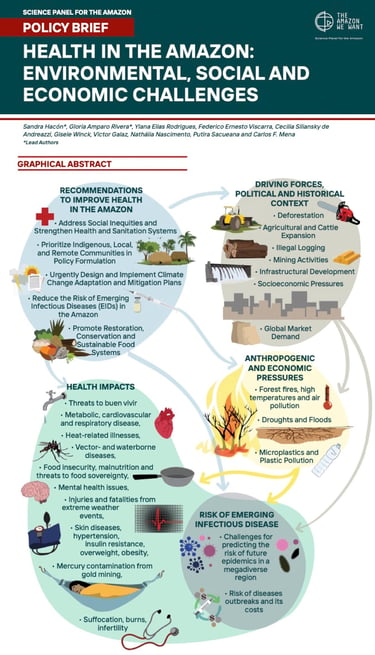
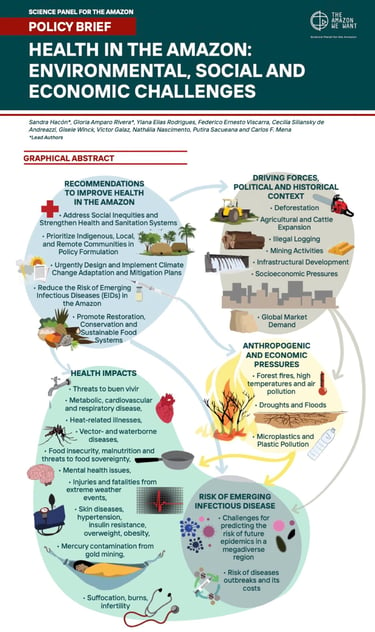
The Scientific Panel for the Amazon (SPA) is the world’s first high-level regional scientific initiative dedicated to the Amazon. Officially established in July 2020 and comprising more than 300 scientists, the SPA integrates indigenous and local knowledge with Western science to develop evidence-based solutions that promote sustainable development. The Scientific Panel for the Amazon has published policy reports on key issues relating to the Amazon region.
Below is a summary of its policy report on health:
Further scientific information on health issues in the Amazon region
‘Key Messages
I. Environmental Degradation Increases Health Risks: Environmental degradation in the Amazon (deforestation, mining, illegal logging, forest fires, unsustainable infrastructure development, crop monoculture, among others) directly increases health risks that exacerbate the susceptibility of local populations to a suite of conditions including, but not limited to, food insecurity, respiratory, cardiovascular, and infectious diseases.
II. Climate Change Intensifies Health Impacts: The Amazon faces a four-fold burden of climate change, biodiversity loss, ecosystem pollution, and deforestation, threatening health of Amazonian people through extreme temperatures, forest fires, land and water pollution, siltation of rivers (especially due to the use of intensive and extensive agrochemicals), droughts, floods, increased mercury loads in aquatic ecosystems, among others.
III. Specific Populations are the Most Vulnerable: Indigenous Peoples and Local Communities (IPLC) are especially vulnerable to droughts, floods, forest fires, food insecurity, and water pollution, facing high rates of malnutrition. Water scarcity and poor quality pose significant challenges in vulnerable regions, including Black, Quilombola, and other Indigenous communities. Furthermore, individuals with pre-existing noncommunicable diseases (NCDs), particularly children and the elderly, are at increased risk due to exposure to air and water pollution, as well as heatwaves.
IV. Healthcare Systems Suffers from Systemic Challenges and Breakdowns: The Amazon region suffers from inadequate health infrastructure, poor access to basic amenities (e.g., clean water, adequate solid waste management, and wastewater treatment), and weak governance, making it difficult to address the health impacts of environmental degradation and climate change effectively.
V. Concerns Growing about Emerging Infectious Diseases (EIDs): The Amazon is increasingly vulnerable to Emerging and Re-Emerging Infectious Diseases due to environmental degradation, deforestation, biodiversity loss, and illegal wildlife trade. These factors bring humans closer to wildlife disease vectors, increasing the risk of zoonotic disease transmission. The disruption of ecosystems not only threatens species and their ecological niches, but also accelerates the spread of pathogens, posing significant health risks locally and globally. Conservation and sustainable practices, as well as innovative technologies are urgently needed to address this growing public health concern.
Recommendations
I. Address Social Inequities and Strengthen Health and Sanitation Systems: Promoting poverty alleviation, gender equity, and community engagement, with a focus on women’s, children’s and elderly’s health and participation in environmental protection, is crucial for improving public health outcomes. Investments in health infrastructure, sanitation, and capacity-building for health professionals are essential to ensure effective healthcare delivery and disease prevention in vulnerable communities.
II. Prioritize Indigenous, Local, and Remote Communities in Policy Formulation: Health service delivery in remote communities must ensure improved distribution of supplies like medicines and rapid tests. During extreme weather events, it is essential to include equipped mobile health units. Strengthening primary care through experienced teams in remote areas and improving access to specialized care, including telehealth, while addressing mental health needs of IPLC, are essential for comprehensive healthcare support.
III. Urgently Design and Implement Climate Change Adaptation and Mitigation Plans: Integrating epidemiological data, Surveillance and Early Warning Systems (EWS), and localized heat stress indices is essential for improving preparedness and responses to climate impacts, while ensuring access to Water, Sanitation and Hygiene (WASH), and health services to promote thermal comfort. Additionally, adaptation measures like promoting greener spaces, improving air quality monitoring, and implementing policies to reduce deforestation and improve energy consumption efficiency are crucial for mitigating climate-related health risks, especially for vulnerable populations.
IV. Reduce the Risk of Emerging Infectious Diseases (eids) in the Amazon: A coordinated transnational response that integrates research agendas, traditional knowledge, surveillance systems, and predictive models is essential for early identification and monitoring of viruses, fungi and bacteria in sentinel populations. Collaborating with international initiatives, promoting the support funding for identification and dissemination of zoonotic risks, and investing in ecological restoration and land-use interventions are critical for mitigating zoonotic disease risks in the Amazon.
V. Promote Restoration, Conservation and Sustainable Food Systems: Halting deforestation is critical for maintaining water bodies, soil productivity, regulating disease vectors, and reducing zoonotic disease risks. Promoting a just energy transition, supporting community-based ecotourism, restoring degraded areas, conserving aquatic ecosystems, and fostering agroecology and food sovereignty are essential for sustainable livelihoods and environmental resilience.’
Sandra Hacón*, Gloria Amparo Rivera*, Ylana Elias Rodrigues, Federico Ernesto Viscarra, Cecilia Siliansky de
Andreazzi, Gisele Winck, Victor Galaz, Nathália Nascimento, Putira Sacueana and Carlos F. Mena. Health in the Amazon: Environmental, Social and Economic Challenges - Science Panel for the Amazon Policy Brief 2024.
Health in the Amazon: environmental, social and economic challenges – Policy report by the Scientific Panel for the Amazon 2024
'The Regional Conference on Traditional Medicine and Indigenous Ancestral Knowledge' was organised by:
Regional Health Directorate (DIRESA)
Peruvian Ministry of Culture
Ucayalí Regional Government
Regional Directorate for the Development of Indigenous Peoples of Ucayalí
Amazonian Indigenous Embassy